

Laparoscopy For Fertility Treatment
Laparoscopy for Infertility Treatment in Rajahmundry
Infertility affects millions of couples worldwide and can arise from a variety of male and female reproductive conditions. For many women, underlying pelvic disorders remain undetected through routine examinations and imaging studies. In such situations, laparoscopy serves as one of the most effective diagnostic and therapeutic procedures available in modern reproductive medicine.
At Pragati IVF Centre, laparoscopy is performed using advanced minimally invasive surgical techniques that allow fertility specialists to accurately diagnose and treat reproductive disorders while minimizing discomfort and recovery time. The procedure enables doctors to examine reproductive organs directly and identify conditions that may interfere with natural conception or assisted reproductive treatments.
Laparoscopic surgery has transformed gynecological care by offering women a safer alternative to traditional open surgery. Through small incisions and advanced imaging technology, surgeons can evaluate and treat various fertility-related conditions with exceptional precision.
Whether you are struggling with unexplained infertility, pelvic pain, endometriosis, ovarian cysts, fibroids, or blocked fallopian tubes, laparoscopy can play a significant role in identifying the root cause and improving your chances of pregnancy.
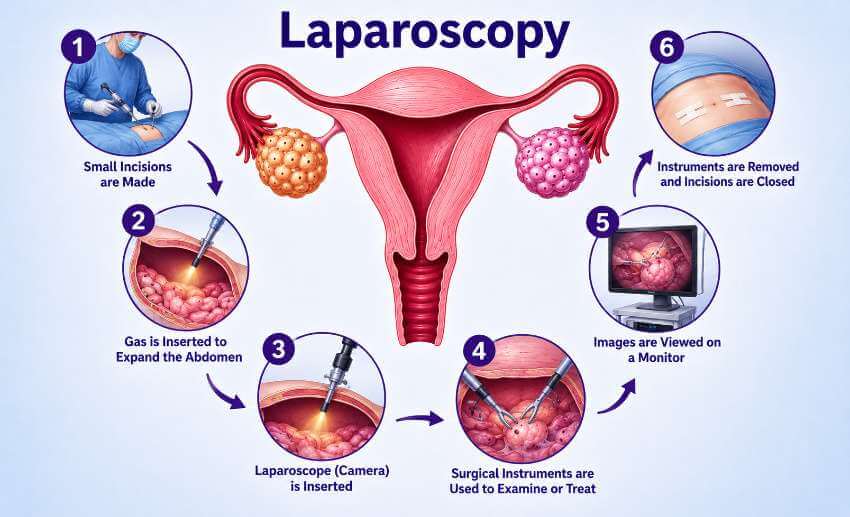
What is Laparoscopy?
Laparoscopy is a minimally invasive surgical procedure that allows doctors to examine the organs inside the abdomen and pelvis without making large surgical cuts.
The procedure utilizes a thin telescope-like instrument called a laparoscope. This device contains a high-definition camera and light source that transmit images onto a monitor, allowing surgeons to visualize internal structures with remarkable clarity.
Unlike conventional surgery, laparoscopy requires only small incisions through which specialized surgical instruments are inserted.
This modern approach offers several benefits:
- Smaller incisions
- Minimal blood loss
- Reduced postoperative pain
- Lower risk of infection
- Faster recovery
- Shorter hospital stay
- Better cosmetic results
- Quicker return to daily activities
These advantages have made laparoscopy the preferred surgical option for diagnosing and treating many gynecological and infertility-related conditions.
Why is Laparoscopy Important in Infertility Treatment?
Infertility often involves conditions that cannot be accurately diagnosed through ultrasound scans, blood tests, or physical examinations alone.
Many fertility-related disorders develop deep inside the pelvis where they remain hidden from conventional diagnostic methods.
Laparoscopy enables fertility specialists to:
- Directly examine reproductive organs
- Detect hidden causes of infertility
- Assess pelvic anatomy
- Evaluate tubal health
- Identify endometriosis
- Diagnose adhesions
- Remove fertility obstacles
- Improve pregnancy outcomes
Because of its diagnostic accuracy, laparoscopy is frequently recommended for women experiencing:
- Unexplained infertility
- Recurrent pregnancy loss
- Chronic pelvic pain
- Suspected endometriosis
- Tubal disease
- Pelvic adhesions
- Ovarian abnormalities
Conditions Diagnosed Through Laparoscopy
Endometriosis
Endometriosis occurs when tissue similar to the uterine lining grows outside the uterus.
This condition can affect:
- Ovaries
- Fallopian tubes
- Pelvic cavity
- Bowel
- Bladder
Symptoms may include:
- Painful periods
- Chronic pelvic pain
- Pain during intercourse
- Infertility
Laparoscopy remains the gold standard for diagnosing endometriosis because it allows direct visualization of abnormal tissue deposits.
Blocked Fallopian Tubes
Healthy fallopian tubes are essential for natural conception.
Blockages may occur due to:
- Pelvic infections
- Endometriosis
- Previous surgery
- Tubal scarring
Laparoscopy can determine:
- Location of blockage
- Severity of damage
- Feasibility of repair
Pelvic Adhesions
Pelvic adhesions are scar tissues that cause organs to stick together.
These adhesions may result from:
- Previous surgeries
- Infections
- Endometriosis
Adhesions can interfere with:
- Egg release
- Fertilization
- Embryo transport
Laparoscopic surgery allows surgeons to remove these adhesions and restore pelvic anatomy.
Ovarian Cysts
Many ovarian cysts resolve naturally.
However, some cysts require surgical treatment due to:
- Size
- Pain
- Risk of rupture
- Fertility concerns
Laparoscopy allows safe cyst removal while preserving healthy ovarian tissue.
Uterine Fibroids
Fibroids are non-cancerous growths that develop in or around the uterus.
They may cause:
- Heavy bleeding
- Pelvic pain
- Reproductive difficulties
Laparoscopic fibroid removal can improve fertility outcomes in selected patients.
Pelvic Inflammatory Disease (PID)
PID can damage reproductive organs and lead to infertility.
Laparoscopy helps assess:
- Extent of infection
- Tubal damage
- Pelvic scarring
Early diagnosis can prevent further reproductive complications.
When is Laparoscopy Recommended?
Your fertility specialist may recommend laparoscopy if:
You Have Unexplained Infertility - When routine fertility tests appear normal but pregnancy does not occur, laparoscopy may reveal hidden pelvic abnormalities.
You Experience Chronic Pelvic Pain - Persistent pelvic discomfort often requires direct visualization of pelvic organs.
You Have Suspected Endometriosis - Laparoscopy remains the most reliable method for confirming endometriosis.
You Have Recurrent IVF Failure - Repeated unsuccessful IVF cycles may indicate underlying pelvic issues that require correction.
You Have Tubal Disease - Laparoscopy helps evaluate fallopian tube function and structure.
How is Laparoscopy Performed?
The procedure is generally performed under general anesthesia.
Preparation - Patients undergo medical evaluation, blood investigations, imaging studies, and anesthesia assessment.
Small Incision - A small incision is made near the navel.
Carbon Dioxide Inflation - The abdomen is gently inflated with carbon dioxide gas to improve visibility.
Laparoscope Insertion - The laparoscope is introduced through the incision.
Pelvic Examination - The surgeon examines the uterus, ovaries, fallopian tubes, and pelvic cavity.
Surgical Treatment - If abnormalities are detected, treatment may be performed during the same procedure.
Completion - Instruments are removed and the incisions are closed. The entire procedure generally takes 30 minutes to 2 hours depending on complexity.
Benefits of Laparoscopy
Modern laparoscopic surgery offers numerous advantages:
Enhanced Diagnosis - Provides direct visualization of reproductive organs.
Better Fertility Outcomes - Corrects structural abnormalities affecting conception.
Faster Recovery - Most patients return home within 24 hours.
Minimal Scarring - Only tiny incisions are required.
Reduced Pain - Less postoperative discomfort compared to open surgery.
Lower Infection Risk - Smaller wounds reduce complications.
Improved Surgical Precision - High-definition imaging allows accurate treatment.
Fertility Enhancing Laparoscopic Procedures
At Pragati IVF Centre, laparoscopy can be used to perform:
- Endometriosis excision
- Ovarian cystectomy
- Adhesiolysis
- Tubal surgery
- Myomectomy
- Ectopic pregnancy management
- Fertility restoration procedures
These treatments help optimize reproductive health and improve conception chances.