

Tubal Blockage? Your IVF Journey Starts Here
Tubal Problems Treatment in Rajahmundry
Tubal problems are one of the leading causes of female infertility. The fallopian tubes play a vital role in natural conception by allowing the egg and sperm to meet and facilitating the transport of the fertilized embryo to the uterus. When one or both tubes become blocked, damaged, scarred, or dysfunctional, pregnancy may become difficult or impossible without medical intervention. At Pragati IVF Centre, Rajahmundry, we provide comprehensive diagnosis and advanced treatment for tubal factor infertility using modern fertility technologies and personalized reproductive care.
What Are Fallopian Tubes?
Fallopian tubes are delicate structures connecting the ovaries to the uterus. Every month, an egg released from the ovary travels through the fallopian tube. Fertilization typically occurs within the tube, after which the embryo travels to the uterus for implantation and pregnancy development. If the tubes are blocked or damaged, this process is disrupted.
Functions of Fallopian Tubes
- Transport eggs from ovaries to uterus
- Facilitate fertilization
- Support early embryo development
- Help embryo implantation by transporting it to the uterus
- Maintain reproductive health
What Are Tubal Problems?
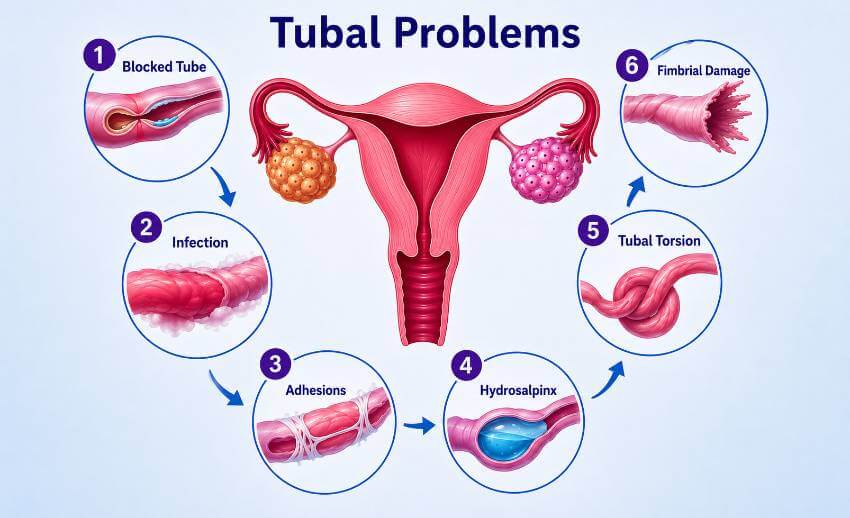
Tubal problems refer to conditions affecting the normal structure and function of the fallopian tubes. These conditions can prevent sperm from reaching the egg, stop fertilization, or block embryo transport to the uterus. Tubal factor infertility occurs when these issues interfere with conception.
Common Tubal Conditions
- Blocked fallopian tubes
- Damaged fallopian tubes
- Hydrosalpinx
- Tubal scarring
- Pelvic adhesions
- Tubal infections
- Tubal dysfunction
- Previous tubal sterilization
How Common Are Tubal Problems?
Tubal infertility contributes significantly to female infertility worldwide. Many women discover tubal issues only after experiencing difficulty conceiving because these conditions often develop silently without obvious symptoms.
Causes of Tubal Problems
Understanding the underlying cause helps determine the most appropriate treatment strategy.
Pelvic Inflammatory Disease (PID)
Pelvic inflammatory disease is one of the most common causes of tubal damage. Untreated infections may cause inflammation, scarring, and blockage of the tubes.
Effects:
- Tubal scarring
- Tubal blockage
- Fertility impairment
- Chronic pelvic pain
Sexually Transmitted Infections
Infections such as chlamydia and gonorrhea can damage the reproductive tract and cause tubal infertility.
Risks:
- Permanent scarring
- Tube blockage
- Increased ectopic pregnancy risk
Endometriosis
Endometriosis can create inflammation and adhesions around the ovaries and fallopian tubes, affecting fertility.
Symptoms:
- Pelvic pain
- Painful periods
- Infertility
- Pain during intercourse
Previous Abdominal or Pelvic Surgery
Surgical procedures may lead to scar tissue formation that affects the tubes.
Examples:
- Cesarean section
- Appendectomy
- Fibroid surgery
- Endometriosis surgery
Ectopic Pregnancy
A previous ectopic pregnancy may damage the affected tube and reduce fertility potential.
Tubal Sterilization
Women who previously underwent tubal ligation may later seek fertility treatment to conceive again.
Types of Tubal Problems
Complete Tubal Blockage
The tube is entirely obstructed, preventing sperm and egg from meeting.
Consequences:
- Natural conception becomes difficult
- Higher fertility treatment requirements
Partial Tubal Blockage
Only part of the tube is blocked.
Risks:
- Delayed conception
- Ectopic pregnancy
- Reduced fertility
Hydrosalpinx
Hydrosalpinx occurs when fluid accumulates inside a blocked fallopian tube. This condition can negatively impact fertility and IVF success rates.
Symptoms:
- Pelvic pain
- Infertility
- Abnormal discharge
- Recurrent implantation failure
Tubal Adhesions
Scar tissue may form around the tubes, restricting movement and egg pickup.
Symptoms of Tubal Problems
Many women have no symptoms until they face infertility challenges. However, some symptoms may occur.
Common Symptoms
- Difficulty conceiving
- Chronic pelvic pain
- Lower abdominal pain
- Painful menstruation
- Pain during intercourse
- Irregular periods
- History of pelvic infection
When Should You See a Fertility Specialist?
Consult a fertility specialist if:
- Trying to conceive for more than one year
- History of pelvic infection
- Previous ectopic pregnancy
- Endometriosis diagnosis
- Recurrent infertility
- Previous pelvic surgeries
Tubal Problems and Infertility
Tubal infertility occurs when damaged or blocked tubes prevent fertilization or embryo transport. Even if ovulation and sperm quality are normal, pregnancy may not occur due to tubal dysfunction.
Effects on Fertility
- Prevents sperm from reaching the egg
- Blocks embryo transport
- Increases miscarriage risk
- Raises ectopic pregnancy risk
Tubal Problems and Ectopic Pregnancy
When fertilization occurs but the embryo cannot reach the uterus, implantation may occur inside the fallopian tube, resulting in an ectopic pregnancy. This condition requires immediate medical attention.
Warning Signs:
- Severe abdominal pain
- Vaginal bleeding
- Dizziness
- Shoulder pain
- Fainting
Diagnosis of Tubal Problems in Rajahmundry
At Pragati IVF Centre, Rajahmundry, we use advanced fertility diagnostics to accurately identify tubal abnormalities.
Medical History Evaluation
Assessment Includes:
- Menstrual history
- Pregnancy history
- Infection history
- Surgical history
Ultrasound Examination
Ultrasound helps assess reproductive organs and identify abnormalities associated with tubal disease.
Benefits:
- Non-invasive
- Quick assessment
- Fertility evaluation
Hysterosalpingography (HSG)
HSG is one of the most commonly used investigations to evaluate tubal patency. A contrast dye is introduced into the uterus and X-rays are taken to determine whether the tubes are open.
Advantages:
- Detects blockages
- Outpatient procedure
- Provides valuable fertility information
Sonohysterography
This ultrasound-based procedure helps evaluate the uterine cavity and fallopian tubes.
Diagnostic Laparoscopy
Laparoscopy is considered one of the most accurate methods for evaluating tubal health. A camera is inserted through small abdominal incisions to directly visualize the reproductive organs.
Benefits:
- Direct visualization
- Detects endometriosis
- Identifies adhesions
- Allows simultaneous treatment
Treatment of Tubal Problems in Rajahmundry
Treatment depends on:
- Severity of damage
- Location of blockage
- Age
- Fertility goals
- Ovarian reserve
- Partner fertility factors
Conservative Management
Some mild tubal abnormalities may only require observation and monitoring.
Suitable For:
- Mild adhesions
- Minimal symptoms
- Early-stage disease
Treatment of Infections
Pelvic infections should be treated promptly to prevent further tubal damage.
Benefits:
- Prevents progression
- Reduces inflammation
- Preserves fertility
Tubal Recanalization
Tubal recanalization is used to open certain types of proximal tubal blockages.
Advantages:
- Minimally invasive
- Outpatient procedure
- May restore fertility
Laparoscopic Tubal Surgery
Minimally invasive surgery can repair selected tubal conditions.
Procedures Include:
- Adhesion removal
- Tubal reconstruction
- Endometriosis treatment
- Hydrosalpinx correction
Benefits:
- Smaller incisions
- Faster recovery
- Reduced pain
- Fertility preservation
Hydrosalpinx Treatment
Hydrosalpinx often requires surgical management before fertility treatment because the fluid can negatively affect implantation and IVF outcomes.
Treatment Options:
- Salpingectomy
- Tubal clipping
- Laparoscopic correction
IVF for Tubal Factor Infertility
In vitro fertilization (IVF) is often considered the most effective treatment for severe tubal damage because fertilization occurs outside the body, bypassing the fallopian tubes entirely.
Advantages of IVF:
- Bypasses blocked tubes
- High success potential
- Effective for severe tubal damage
- Suitable after failed surgery
Success Rates of Tubal Problem Treatment
Success depends on:
- Patient age
- Severity of damage
- Ovarian reserve
- Presence of endometriosis
- Duration of infertility
- Chosen treatment
Early diagnosis generally improves reproductive outcomes.
Why Choose Pragati IVF Centre for Tubal Problems Treatment in Rajahmundry?
Pragati IVF Centre offers advanced fertility evaluation and personalized reproductive care for women with tubal infertility. The centre provides modern diagnostic facilities, IVF treatment, laparoscopy, and comprehensive infertility management under experienced fertility specialists.
Experienced fertility specialists - Dedicated experts with extensive experience in tubal infertility management.
Advanced IVF laboratory - State-of-the-art facilities for fertility treatment.
Modern laparoscopy facilities - Minimally invasive surgical expertise.
Personalized treatment plans - Tailored according to each patient's needs.
Comprehensive infertility care - Full range of fertility services under one roof.
Fertility preservation options - Focus on protecting reproductive potential.
Patient-centered approach - Compassionate and supportive care.