


Advanced Preimplantation Genetic Testing
for Healthy Embryo Selection
Preimplantation Genetic Testing (PGT) in Rajahmundry
Preimplantation Genetic Testing (PGT) is a cutting-edge advancement in IVF treatment that helps identify genetic abnormalities in embryos before implantation. At Pragati IVF Centre and Multispeciality Hospital, Rajahmundry, we offer advanced PGT testing in IVF to improve pregnancy success rates and ensure the birth of a healthy baby.
PGT plays a vital role in modern fertility treatments by allowing fertility specialists to select the healthiest embryos, thereby increasing the chances of successful implantation and reducing the risk of miscarriage and genetic disorders.
What is Preimplantation Genetic Testing (PGT)?
Preimplantation Genetic Testing (PGT) is a specialized laboratory procedure performed during In Vitro Fertilization (IVF). It involves screening embryos for genetic abnormalities before transferring them into the uterus.
This advanced genetic screening helps detect:
- Chromosomal abnormalities (like Down syndrome)
- Single gene disorders (such as thalassemia)
- Structural chromosomal rearrangements
PGT ensures that only genetically healthy embryos are selected for transfer, significantly improving the chances of a successful pregnancy.
Types of PGT in IVF Treatment
PGT is broadly classified into three main types, each designed to address specific genetic concerns.
- PGT-A (Preimplantation Genetic Testing for Aneuploidy) - PGT-A is the most commonly performed test in IVF. It screens embryos for abnormal chromosome numbers. Aneuploidy is one of the leading causes of implantation failure and miscarriage.
- PGT-M (Preimplantation Genetic Testing for Monogenic Disorders) - PGT-M is used when one or both parents carry a genetic mutation. It helps detect inherited diseases such as cystic fibrosis, sickle cell anemia, or muscular dystrophy.
- PGT-SR (Preimplantation Genetic Testing for Structural Rearrangements) - PGT-SR is designed for individuals with chromosomal rearrangements like translocations or inversions. These conditions can lead to repeated IVF failure or miscarriage.
Why is PGT Important in IVF?
The success of IVF largely depends on embryo quality. Even healthy-looking embryos may carry hidden genetic abnormalities that can lead to implantation failure or miscarriage.
PGT improves IVF outcomes by identifying these abnormalities early, allowing fertility specialists to transfer only the most viable embryos.
Studies show that genetic abnormalities in embryos are a major cause of failed pregnancy, making PGT a critical step in improving fertility outcomes.
Benefits of Preimplantation Genetic Testing
PGT offers several advantages that make it one of the most recommended add-ons in IVF treatment, especially for high-risk patients.
- Improved IVF Success Rates
- Reduced Risk of Miscarriage
- Prevention of Genetic Disorders
- Better Embryo Selection
- Shorter Time to Pregnancy
Who Should Consider PGT?
PGT is not necessary for all patients, but it is highly recommended for individuals with specific fertility challenges.
- Are above 35 years of age
- Have experienced recurrent miscarriages
- Have had repeated IVF failures
- Carry a genetic disorder
- Have a family history of inherited diseases
- Have chromosomal abnormalities
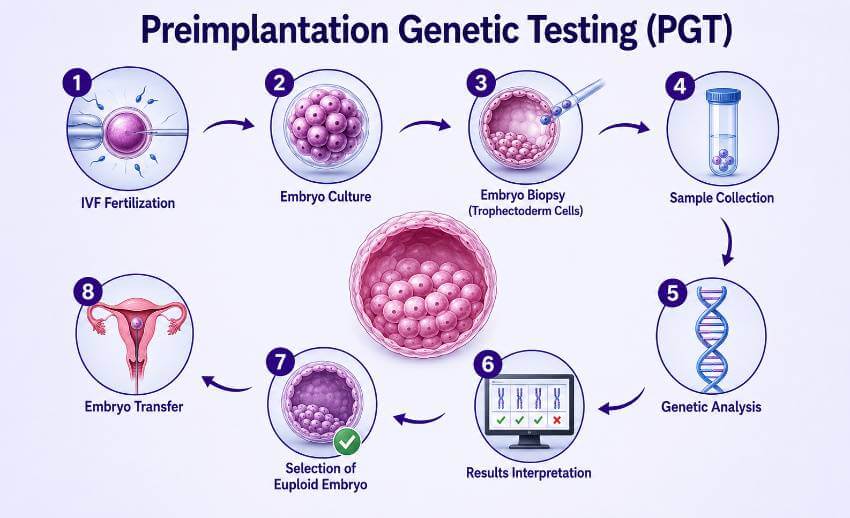
PGT Procedure Step-by-Step
- Ovarian Stimulation and Egg Retrieval - The process begins with controlled ovarian stimulation to produce multiple eggs, followed by egg retrieval.
- Fertilization (IVF or ICSI) - The eggs are fertilized with sperm in the laboratory to form embryos.
- Embryo Development - Embryos are cultured for 5鈥�6 days until they reach the blastocyst stage.
- Embryo Biopsy - A few cells are carefully removed from each embryo for genetic testing.
- Genetic Analysis - The biopsied cells are analyzed using advanced genetic technologies to detect abnormalities.
- Embryo Transfer - Only healthy embryos are selected and transferred into the uterus.
Success Rates of PGT in IVF
PGT has shown promising results in improving IVF outcomes, especially in certain groups of patients.
- Clinical pregnancy rates have shown improvement with PGT in many studies
- It is particularly effective for women above 35 years
- It helps reduce miscarriage rates significantly
- Some studies report clinical pregnancy rates as high as 82% with PGT compared to 70% without it, indicating improved outcomes
- Additionally, research shows that PGT can improve live birth rates and reduce the number of embryo transfers needed, especially in older patients
Limitations of PGT
- It does not guarantee pregnancy success
- It may reduce the number of embryos available for transfer
- Additional cost is involved
- Results may vary depending on age and individual fertility conditions
Why Choose Pragati IVF Centre for PGT in Rajahmundry?
- Advanced genetic testing laboratory
- Experienced fertility specialists
- High success rates in IVF and PGT
- Customized fertility treatment plans
- State-of-the-art embryology lab