

Improve IVF Success with
Assisted Hatching Technology
Assisted Hatching in IVF Treatment in Rajahmundry
Assisted Hatching is an advanced laboratory technique used in IVF treatment (In Vitro Fertilization) to enhance the chances of embryo implantation. At Pragati IVF Centre and Multispeciality Hospital, Rajahmundry, we offer cutting-edge fertility solutions including laser assisted hatching, designed to improve pregnancy outcomes for couples facing infertility challenges.
Infertility treatments have evolved significantly, and assisted hatching is one such innovation that helps embryos successfully implant in the uterus. For patients who have experienced repeated IVF failures or poor embryo quality, this technique can provide renewed hope.
What is Assisted Hatching in IVF?
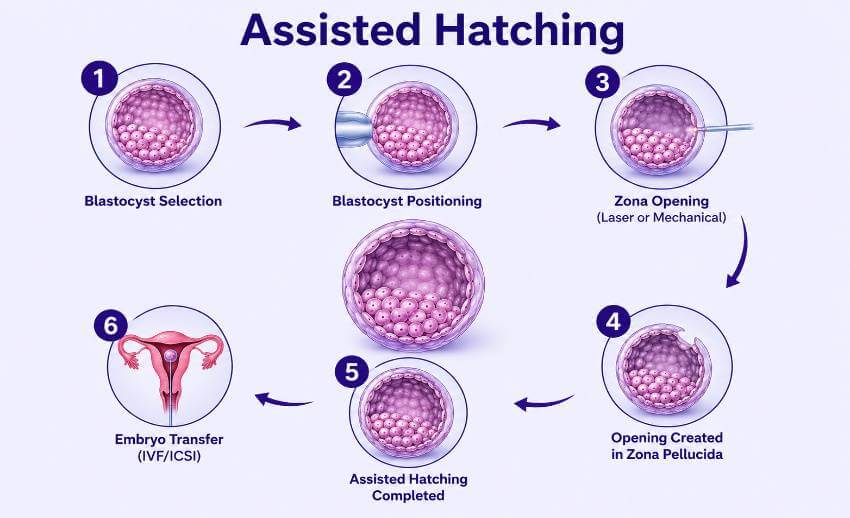
Assisted hatching is a specialized procedure where a small opening is created in the outer layer of the embryo, called the zona pellucida, to help it “hatch” and attach to the uterine lining. This step is crucial because implantation cannot occur unless the embryo breaks out of this protective shell.
In natural conception, the embryo hatches on its own. However, in IVF cycles, especially in certain cases, this process may not occur efficiently. Assisted hatching helps overcome this barrier, increasing the chances of successful implantation and pregnancy.
Why is Assisted Hatching Recommended?
Not every IVF patient requires assisted hatching. It is typically recommended in specific cases where implantation is difficult. High-volume search keywords such as “who needs assisted hatching,” “IVF failure reasons,” and “implantation failure treatment” are commonly associated with this topic.
Doctors may suggest assisted hatching for:
- Women above 35–37 years of age
- Patients with repeated IVF failure
- Embryos with a thick zona pellucida
- Frozen embryo transfer cycles
- Poor embryo quality
- Cases involving genetic testing (PGT)
Research shows that assisted hatching may improve pregnancy chances in patients with previous unsuccessful IVF cycles or poor prognosis.
How Assisted Hatching Works
The assisted hatching procedure is performed in a highly controlled embryology lab by experienced specialists. It is usually done before embryo transfer, typically on day 3 or day 5 of embryo development.
- Step-by-Step Process: The embryologist carefully examines the embryo under a microscope.
- A precise opening is made in the outer shell using advanced techniques such as:
- Laser-assisted hatching (most preferred method)
- Mechanical hatching
- Chemical hatching
Among these, laser assisted hatching is widely used because of its precision and safety. A controlled laser beam creates a tiny opening without damaging the embryo, allowing it to implant more easily.
After the procedure, the embryo is transferred into the uterus, where it continues the natural implantation process.
Benefits of Assisted Hatching
Assisted hatching has gained popularity due to its potential to improve IVF success rates, particularly in selected patients. It is commonly searched as “benefits of assisted hatching in IVF” and “IVF success rate improvement techniques.”
- Improves embryo implantation chances
- Helps embryos with thick outer shells
- Beneficial in frozen embryo transfers
- Increases success in repeated IVF failures
- Supports better outcomes in older women
Studies indicate that assisted hatching can increase implantation rates and clinical pregnancy rates in certain groups of patients.
In some cases, implantation rates may increase from around 15–20% to 25–30% with assisted hatching.
Assisted Hatching Success Rates
When discussing “assisted hatching success rate,” it is important to understand that outcomes vary depending on individual patient factors such as age, embryo quality, and overall reproductive health.
Some studies have shown improved pregnancy rates, especially with laser-assisted techniques, while others suggest the benefits are more significant in selected cases rather than all IVF patients.
For example, certain clinical findings have reported pregnancy rates of over 50% with laser-assisted hatching compared to lower rates without it in specific patient groups.
However, it is important to note that assisted hatching is not a guaranteed solution but an add-on technique that enhances the chances of implantation.
Risks and Safety of Assisted Hatching
Assisted hatching is generally considered safe when performed by experienced embryologists. However, like any medical procedure, it carries minimal risks.
- Rare chance of embryo damage
- Slight increase in identical twin pregnancies
- Possibility of implantation failure despite the procedure
Studies highlight that the risk of identical twins may increase due to embryo splitting after hatching.
At Pragati IVF Centre, we follow strict laboratory protocols to ensure maximum safety and success for every patient.
Who Should Consider Assisted Hatching?
Assisted hatching is not recommended for all IVF patients. It is most effective when tailored to the individual’s medical condition.
- Have had multiple failed IVF cycles
- Are undergoing frozen embryo transfer
- Are above 35 years of age
- Have embryos with poor development
- Are opting for advanced fertility treatments
Fertility specialists carefully evaluate each case before recommending this procedure to ensure the best possible outcomes.
Assisted Hatching vs Other IVF Techniques
Many patients search for comparisons like “assisted hatching vs ICSI” or “IVF add-ons explained.”
It is important to understand that assisted hatching is different from other techniques:
- ICSI (Intracytoplasmic Sperm Injection) helps fertilization
- Assisted Hatching helps implantation
Both procedures can be used together in an IVF cycle to improve overall success rates.
Why Choose Pragati IVF Centre for Assisted Hatching?
- Experienced fertility specialists and embryologists
- Advanced embryology lab with laser-assisted hatching technology
- High success rates in IVF treatments
- Personalized fertility treatment plans
- Compassionate patient support